


This article is part of Built to Handle the City: The Skin Resilience Series.
Urban skin needs more than a temporary shield. It needs a reliable barrier that can manage repeated exposure to pollution, smog, dust, dry air, indoor heating, temperature changes, and daily cleansing.
The skincare conversation is moving from protection to resilience:
Protect → repair → strengthen → resist → adapt → recover.
This does not mean making sensitive skin tougher through harsh treatments. It means supporting the skin’s own structure with a simple, consistent routine.
What skin resilience means
Skin resilience is the ability of the skin barrier to maintain hydration, limit irritation, and recover after environmental stress.
The skin barrier is the outermost layer of the epidermis. It helps keep water inside the skin and limits the entry of irritants. Its structure is often compared with bricks and mortar:
- Skin cells act as the bricks.
- Lipids, including ceramides, cholesterol, and fatty acids, act as the mortar.
- Natural moisturizing factors help hold water within the outer layer.
When this structure is balanced, skin usually feels comfortable and flexible. When it is weakened, water escapes more easily and external stressors can cause a stronger reaction.
Research has linked air pollution with oxidative stress, inflammation, increased water loss, and impaired barrier function. Fine particulate matter may also have a greater effect when the barrier is already damaged. Read the review of environmental air pollutants and skin function for a detailed overview.
Protection is not the same as resilience
An anti-pollution product may help reduce the contact between skin and environmental particles. This is useful. However, a protective layer alone cannot replace barrier care.
Think of the difference in practical terms:
| Protection | Resilience |
|---|---|
| Helps limit contact with a specific stressor | Supports the skin’s ability to cope with repeated stress |
| May focus on surface shielding | Focuses on hydration, lipids, and recovery |
| Works during exposure | Supports the barrier before, during, and after exposure |
| Addresses one part of the problem | Addresses the full daily routine |
City life creates several types of exposure at once. Pollution may sit on the skin. Cold wind may increase dryness. Indoor heating may reduce humidity. Frequent washing may remove surface lipids. Temperature changes may increase discomfort.
A resilient routine addresses these pressures without adding unnecessary steps.
Why “Skin Barrier 2.0” is gaining attention
The skin barrier has become a top-five skincare concern. Consumers are also becoming more aware that aggressive exfoliation does not always improve skin quality.
The current barrier-first approach prioritizes the lipid mortar rather than repeatedly removing surface cells. This means:
- Reduce unnecessary exfoliation.
- Avoid harsh scrubbing.
- Use gentle cleansing.
- Replace hydration and lipids.
- Allow time for the skin to recover.
- Add active treatments only when the barrier is stable.
This is a practical response to a common pattern: skin feels rough or dull, so more acids or retinoids are added. The result may be temporary smoothness followed by tightness, redness, stinging, or increased sensitivity.
When the barrier is fragile, repair should come before correction.

Signs that your skin barrier may be fragile
A fragile barrier can present in different ways. Check for repeated or worsening symptoms rather than one isolated reaction.
Common signs include:
- Tightness after cleansing.
- Dry patches or visible flaking.
- Stinging when applying normally comfortable products.
- Redness that appears easily.
- Increased sensitivity to cold, wind, or indoor heat.
- Rough or uneven texture.
- Dehydration lines.
- A feeling that moisturizers no longer last.
- More frequent reactions to new products.
- Skin that feels both dry and congested.
These signs can have several causes, including eczema, rosacea, allergic contact dermatitis, medication, or other skin conditions. Consult a dermatologist if symptoms persist, become painful, spread, or affect your daily life.
What actually helps build resilience
1. Replenish the lipid structure
Ceramides, cholesterol, and fatty acids are important components of the skin’s natural barrier. Products that include barrier-supporting lipids can help improve comfort and reduce moisture loss.
The goal is not to select the longest ingredient list. The goal is to use a well-formulated product consistently.
2. Add water and help keep it there
Humectants such as glycerin and panthenol attract water. They work best when followed by a cream that helps reduce water loss.
Panthenol can also support a more comfortable feel in dry or stressed skin. Apply moisturizer to slightly damp skin when possible. This helps limit the time water remains exposed to dry air.
3. Consider modern stress-support ingredients
Several ingredients are appearing more often in resilience-focused skincare:
- Ectoin: Used in formulas designed to support skin under environmental stress.
- Centella asiatica: Often selected for calming and comfort-focused formulations.
- Postbiotics: Used to support the relationship between the skin barrier and its microbial environment.
- Ceramides: Help replenish barrier lipids.
- Cholesterol and fatty acids: Support the lipid structure of the outer skin layer.
- Panthenol: Supports hydration and comfort.
Ingredient names are only the starting point. Concentration, stability, delivery system, compatibility, and the complete formula matter more than a single trending ingredient.
A product does not become effective simply because it contains a familiar name. Review the full ingredient list, test new products carefully, and avoid changing several products at the same time.
Seasonal stress: dehydration comes first
When outdoor humidity drops and indoor heating increases, the skin may lose water more quickly. Dehydration often appears before visible irritation.
The sequence may look like this:
- Skin feels less supple.
- Fine lines become more visible.
- Tightness develops after cleansing.
- Dry patches appear.
- Sensitivity increases.
- Products begin to sting.
Cold air and wind can add further stress. Moving repeatedly between cold streets and warm, dry offices can make the skin feel less stable.
Adjust the routine before discomfort becomes severe. Use a gentle cleanser, apply moisturizer regularly, and avoid increasing exfoliation to address rough texture.
Skin streaming and the case for fewer products
“Skin streaming” and skinimalism reflect a useful shift: fewer, multifunctional products may be more suitable than a 10-step routine, especially for sensitive skin.
A minimal routine reduces:
- The number of possible irritants.
- The chance of incompatible active ingredients.
- The difficulty of identifying the cause of a reaction.
- The amount of cleansing needed.
- The time required to maintain the routine.
A basic routine can provide cleansing, hydration, barrier support, and daily photoprotection without excessive layering.

A simple urban skincare routine
Morning
-
Cleanse gently or rinse with water.
Choose the option that leaves skin comfortable. Avoid over-cleansing. -
Apply one targeted product if needed.
If you use an antioxidant or calming serum, introduce it only when the skin barrier is stable. -
Apply a sensitive skin moisturizer.
Select a fragrance-free formula with hydrating and barrier-supporting ingredients. -
Apply broad-spectrum sunscreen.
Sunscreen remains essential for protection from UV exposure. A moisturizer or anti-pollution cream does not replace sunscreen unless it is specifically labeled and tested as a sunscreen.
Evening
-
Remove sunscreen, makeup, and surface particles.
Use a gentle cleanser. Double cleanse only when necessary and avoid excessive rubbing. -
Apply barrier support.
Use a skin barrier repair cream while the skin is slightly damp. -
Pause strong actives if skin stings.
Temporarily reduce acids, retinoids, scrubs, and fragranced products when the skin feels irritated. -
Repeat consistently.
Resilience is built through regular care, not occasional intensive treatments.
Where City Protection Replenishing Cream fits
City Protection Replenishing Cream is designed for sensitive, dry, and allergy-prone skin exposed to daily city conditions.
Its role is straightforward:
- Restore the skin’s hydrolipidic barrier.
- Provide deep, long-lasting hydration.
- Help protect against smog, dust, and pollution.
- Support a comfortable daily routine.
- Provide a fragrance-free, 97% plant-based formula.
It can be used as the main moisturizer in a minimal morning and evening routine. Apply a small amount after cleansing and allow it to absorb before sunscreen in the morning.
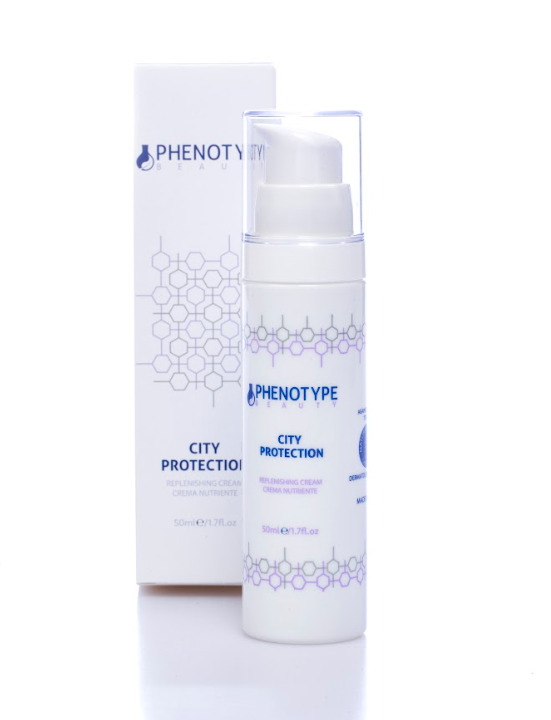
The product is listed at $40 on the Phenotype Beauty website. Review the product information and ingredient list before use. If your skin is allergy-prone or recovering from a medical procedure, complete a patch test and follow advice from your healthcare professional.
Build a routine that can recover
Resilient skin is not skin that never reacts. It is skin supported by a routine that limits unnecessary stress and helps it recover.
Use the following structure:
- Cleanse without stripping.
- Replace water and lipids.
- Reduce unnecessary exfoliation.
- Choose fragrance-free products when sensitivity is a concern.
- Add one new product at a time.
- Use sunscreen daily.
- Adjust for humidity, heating, wind, and temperature changes.
- Keep the routine consistent.
Urban skincare does not need to be complicated. Build the barrier first. Then allow the skin to strengthen, resist, adapt, and recover from city life.
Leave a Reply